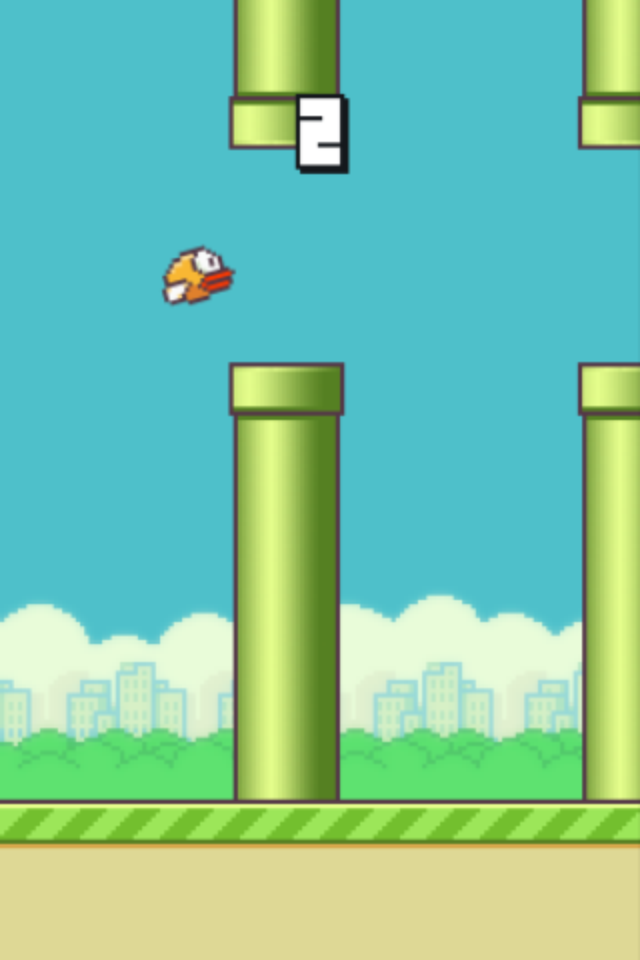
Good news – I just played 100 games of Flappy Bird and recorded my scores.
Flappy Bird synopsis: Your job in this game is to navigate a bird through a series of gaps between pipes. If your bird manages to pass through 3 openings but then crashes into a pipe or falls to the ground, the game is over, and your final score is 3. The game is immensely difficult, despite the fact that the gameplay never speeds up and the gaps between the pipes never shrink.
I don't mean to brag, but I've wasted a lot of time on this game, so I'm pretty good. Here's what I've become curious about: Let's say I want to break my high score of 146. If I play one game, what are the odds that I surpass 146? How many games should I expect to play before I beat my high score?
To take a stab at this problem, I'm going to make a not-technically-correct-but-not-totally-unreasonable assumption: I can navigate my bird through each gap with some probability $p$, and whether my bird makes it through one gap has no bearing on whether he
1 survives the next gap (i.e., these events are
independent). Once I know what $p$ is, I can find the probability that I get a score of, say, 3, by computing $p^{3}(1-p)$ (the probability that my bird survives the first three gaps but not the fourth).
2 In general:
\[P(\mbox{I get a score of } k) = p^{k}(1 - p)\]
In order to approximate $p$, I recorded my scores from 100 dreadful games of Flappy Bird. During those 100 games, I guided my bird through 2,551 gaps. That means that I encountered 2,651 gaps, 2,551 of them successfully, which gives me $p \approx 2551/2651 \approx 0.9623$. There's about a 96 percent chance that my bird will survive each gap – assuming, of course, that I didn't get significantly better or worse during those 100 games. Now, we have a simple model:
\[P(\mbox{I get a score of } k) = (0.9623)^{k}(1 - 0.9623)\]
Let's put this model to the test by plotting a histogram of my scores (the blue bars) along with the distribution of scores predicted by our model (the red circles):
I'm actually quite pleased with this – the distribution of my scores doesn't follow the model's predictions perfectly, but I wouldn't expect perfection since I only played 100 games. If I recorded 100 more scores (which isn't going to happen), the plot would probably look even smoother.
Recall the question at hand: How many games do I have to play before I beat my high score of 146? Using my value of $p$, we can predict the probability of achieving a score of at least 147:
\[P(\mbox{I get a score of at least } 147) = (0.9623)^{147} = 0.003509\]
This means that I should expect to exceed 146 points roughly 0.3509 percent
3 of the time, or about once every 285 games. Conveniently, this also means that I should expect to play about 285 games before I beat my high score.
4 Of course, 285 is just an
expected value, and it could take me 2 games or 2,000 games for me to beat my high score.
Notice that even though the game never increases in difficultly (i.e., the hundredth gap is no more difficult than the fiftieth gap), getting a score of 100 is significantly more difficult than getting a score of 50. In fact, for me, getting a score of 100 is only $(0.9623)^{50} = 0.1462$ times as likely as getting a score of 50.
1 Or she.
2 This is a
geometric distribution.
3 If you're playing along and you got 0.3521 percent, you're using the rounded value of 0.9623 where I'm using the not-as-rounded value of something like 0.9622783855149. This doesn't change anything significantly, and as you may have noticed, I'm not super focused on precision here.
4 The number of games it will take for me to beat my high score also follows a
geometric distribution.


